The Price Tag Is Not the Whole Cost
Compare the real cost of buying an item by weighing its purchase price against upkeep, consumables, storage and replacement uncertainty.
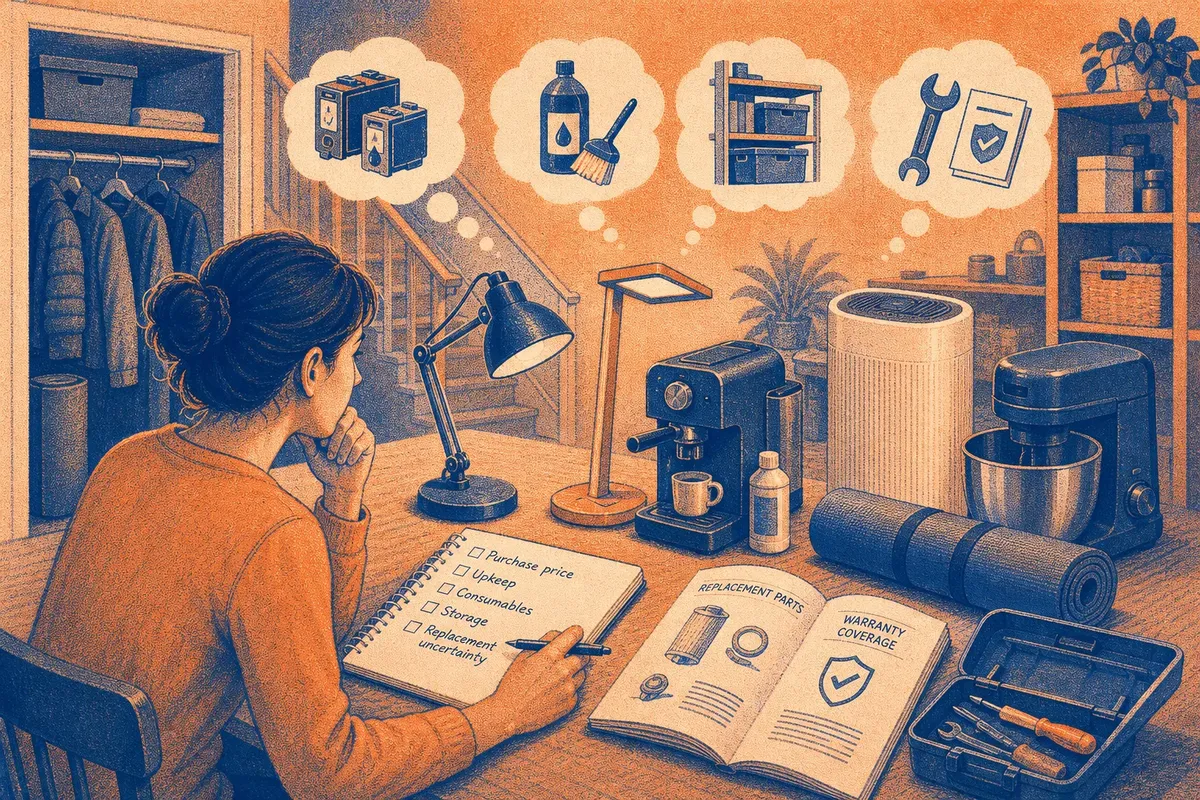
A low purchase price can hide the cost of filters, special supplies, awkward storage or an early replacement. To compare the real cost of a purchase, look beyond the shelf label and map the demands the item is likely to make on your time, space and budget.
This is not a hunt for a perfectly precise total: future repairs and replacement dates are uncertain. The useful aim is to spot costs you can identify now, then decide whether the cheaper option still fits your habits.
When the cheap option stalls
A budget item can seem like the obvious choice until it needs supplies that are sold separately. A printer, for instance, may require a particular ink cartridge; a water filter may take a proprietary replacement. The cause is often a purchase price that draws attention away from the ongoing relationship between the product and its consumables.
Before buying, check the product manual or manufacturer’s listing for the exact consumable type, where it is sold and whether alternatives are compatible. If those details are hard to find, treat that uncertainty as a drawback rather than assuming the supplies will be easy to source.
Say you are choosing between two desk lamps, and one uses a standard replaceable bulb while the other needs a specific module. If you already keep the standard bulb type at home, the first lamp may fit your routines better; if you prefer the second design, confirm that its module is readily available before deciding.
When upkeep goes unused
Some products look economical only if you follow a maintenance routine you are unlikely to keep. A coffee machine that needs regular descaling or a jacket that calls for specialist cleaning can impose effort as well as expense. The usual mismatch is between the care the maker recommends and the care the owner will realistically provide.
Look up the routine before checkout, then compare it with your ordinary week. Check whether the task needs a particular cleaner, a tool you do not own, a service appointment or time to dry and store the item. If upkeep sounds burdensome, a simpler model may be the better value even if its initial cost is higher.
Choose for the maintenance you will actually do, not the routine you hope to adopt.
When storage is overlooked
Large or awkward items can create costs without sending a bill. A folding exercise mat needs somewhere to dry and sit; a bulky kitchen appliance can displace something used more often. The hidden cost is the space it claims, plus the inconvenience of retrieving and putting it away.
Before committing, identify a real storage spot and consider how the item will move from that spot to where it is used. Check dimensions and setup requirements on the product listing, but also think about doors, stairs and nearby furniture. If you cannot name a sensible place for it, pause rather than relying on an imagined future rearrangement.
When replacement is uncertain
It is tempting to decide that a sturdier product will last longer, then treat that assumption as a settled saving. Yet durability depends on construction, use, care and access to repair parts. Product descriptions may reveal materials and warranty terms, but they cannot tell you exactly when your own item will need replacing.
Use evidence you can inspect: whether common wear parts are replaceable, whether repair instructions or spare parts are available, and what the warranty excludes. A warranty describes the maker’s stated coverage, not a promise that every failure will be repaired or that the product will suit your needs for a particular period.
When the likely replacement date is unknowable, compare plausible scenarios instead of inventing a precise lifespan. Ask whether you could still accept the purchase if it needed attention sooner than hoped, and whether a repair would be practical.
When comparisons become false
Two products are hard to compare if you count every possible cost for one and only the shelf price for the other. The cause is often an uneven comparison: one option gets a detailed imagined future, while the other benefits from assumptions left unexamined.
Use the same questions for each candidate:
- What must be bought separately for normal use?
- Which consumables or replacement parts does it require?
- What regular care does the maker recommend?
- Where will it be stored, and is it easy to access?
- What signs suggest it can be repaired rather than discarded?
- Which costs are known, and which remain uncertain?
Do not force every answer into a single total. Mark known costs, such as a required accessory listed by the seller, separately from possibilities, such as a repair you may never need. This makes the comparison clearer without pretending to predict the future.
Questions before buying?
How do I compare products with different upkeep?
Write down each item’s required care, consumables and likely storage demands, then compare those demands with your actual routines. Prefer the option whose maintenance you can comfortably manage, rather than treating a hypothetical ideal routine as certain.
Should I pay more for a repairable item?
First check whether useful parts, repair guidance or service are genuinely available for that model. Paying more may suit you if repairability matters, but it is not automatically better value if repairs are inaccessible or the item does not meet your needs.
How can I account for replacement?
Record what is known about construction, spare parts and warranty coverage, then leave the timing uncertain. Consider whether the purchase would remain acceptable if replacement came earlier than you hope, rather than assigning it an unsupported lifespan.
What if I cannot find clear product details?
Ask the seller or manufacturer about consumables, care and replacement parts before committing. If answers remain vague, compare another option or decide whether you are comfortable accepting that unknown.
A more useful decision
Once you have checked the purchase price, upkeep, consumables, storage and replacement uncertainty, decide which demands matter most to you. One buyer may value a compact design; another may prefer standard supplies or easy access to parts. The real cost of a purchase is personal as well as financial, because inconvenience and unused space count in everyday ownership.
Keep a short note of the known costs and unanswered questions beside the product listing. If the item still makes sense after those questions are visible, you can choose it with a clearer view of what ownership may involve.

Reading a Fabric Care Label Without Guesswork
Reading a fabric care label helps you decode garment instructions, inspect vulnerable details and choose a…
A Home Inventory That Helps When You Need It
A home inventory makes possessions easier to identify and describe. Record useful details, organise clear photos…